© 2008-2011 Farnsworth Clan Adventure All Rights Reserved

© 2008-2013 Farnsworth Clan Adventure All Rights Reserved
Please ask permission before using any portion of our blog. Thanks!
Showing posts with label Luxor. Show all posts

Saturday, January 9, 2010

Egypt: Temple of Karnak-Nile River


While we were visiting Luxor, we also went to the temple of Karnak, the temple of Luxor, and took a boat ride on the Nile River.

The Egyptian civilization was dependant on the Nile River for life.  Without this river (the longest river in the world--yes, it is longer than the Amazon), Egypt would not have developed the ancient kingdoms or even progressed to the level of civilization and culture that came from this fertile, warm environment.  Even today, the Egyptians realize that the waters of the Nile allow their country to survive.  For thousands of years, the river flooded the lands along the flood plain, depositing rich soil and providing the necessary water to grow the crops.  The Nile River is truly the lifeblood of this entire country. 


The "Cruise Boat" that we rode on the Nile River.
 
 Looking from the west bank of the Nile towards Luxor on the east shore.  In ancient times, the city was built on the east side of the river.  The tombs (Valley of the Kings, etc) and the burial sites are all on the western side of the river.  The Sun God, Ra comes up in the east--signifying birth, and sets in the west--signifying death.
 
Many people ride these cruise boats from Cairo up the Nile to Luxor and then further south to the Aswan Dam.  The dam was built in the 1960s.  Since then, the flooding has been controlled.
 
 The old style boats that sail on the Nile.
 
 Prime water buffalo.  It almost makes me homesick for my Angus cows.
 
Water buffalo and donkeys.
 
Looking west from the Nile towards the Valley of the Kings and Hatshepsut's temple.  Notice the extreme difference between the green along the river and the brown hills in the distance.
 
 The entrance to Karnak Temple.  Actually, Karnak is a complex of temples dedicated to several Gods.  In ancient times, this area was under water, allowing the Egyptians to travel by boat all the way to the gates of the temple.
 
 Ram headed statues guarding the entrance to the temple.
 
 An ancient obelisk.
 
More statues within the courtyard of the temple.
 
The remnants of ancient pillars in the courtyard.
 
Statue of Ramses II with his wife in front of him (and Mel in front of them both).  Ramses II was the primary builder of this magnificent temple although several pharaohs added to the temple complex.  Ramses II was a warrior pharaoh. 
 
 Huge stone columns in the temple.  There were 134 of the columns--amazing!!
 
 Angus is dwarfed standing among the columns of the temple.  Originally, the floor of this part of the temple (the Hypostyle Hall) was covered with sheets of gold and silver.
 
 Originally, this part of the temple had a roof.  The slatted area is a window.
 
 Writing on one of the columns.  This is the name of Ramses II in Egyptian hieroglyphics indicating that he was the builder of this part of the temple.
 
 "R" rated drawing of Ramses II.  This is used to signify that Ramses II was very fertile.  He had 54 wives.  From those wives, he fathered approx 96 sons and 102 daughters (these numbers were given to us by our guide).  I would call that "fertile".  He reigned as pharaoh for 67 years.


Outside of one of the temples.
 
 The "Tree of Life" depicting Ramses II in the center.  This indicates that Ramses considered himself as allowing life to exist and continue for his kingdom.
 
 Two very tall obelisks in the temple complex.  The top of the obelisk forms a pyramid.  These obelisks were carved from one piece of granite.  They were carried from above the falls at the present day, Aswan Dam, to Luxor--several hundred miles.

Friday, January 1, 2010

Egypt: Luxor

We took a day trip to Luxor, Egypt to visit some of the sights there.  Luxor (Thebes) was the capital city of the Egyptians during the New Kingdom.  The flight from Sharm el Sheikh took about 35 minutes.  Luxor is the area where the Valley of the Kings is located.  Other major historical sites located in Luxor are the Temple of Luxor, the Temple of Karnak, and the mortuary temple of Hatshepsut, the female pharaoh.

Luxor-farmland close to the Nile River.
 
 Small farms near Luxor.
 
 Where there is water, the land is green.
 
 Donkey carts-a primary mode of transport for the local farmers.
 
 More donkeys.
 
 Between the temples of Karnak and Luxor, they found a row of Sphinx lining the ancient street.  The distance between the two temples is 3 kilometers.  There are estimated to be 1200 Sphinx--many yet to be uncovered.
 
 The mortuary temple of Hatshepsut-the female Pharaoh.  She ruled Egypt for over 20 years as the Pharaoh.  For a woman to rule for this long was very unusual.  Other royal women had ruled as king, but only when there were no male heirs to the throne.  Their reigns were short and generally came at the end of a dynasty.
Hatshepsut's father was Tuthmosis I, her mother, Ahmose, was the royal queen (the primary wife of the pharaoh).  She was married to her half-brother, Tuthmosis II.  At the death of Tuthmosis II, the crown prince, Tuthmosis III was still a child (about 7 years old).  Hatshepsut was the mother of only one child--a daughter.  The daughter was then married to her half-brother, Tutmosis III.
Hatshepsut took over control of the government and sent the young crown prince away to the military.  She left him there for the duration of her reign--about 20 years.  Hatshepsut built this temple in her honor.  After her death, her son-in-law, Tuthmosis III came into power.  He took revenge upon Hatshepsut by destroying everything in Hatshepsut's temple with her name or picture.  Tuthmosis III couldn't destroy the temple because it was considered sacred--but that didn't stop him from eliminating her name from the temple.
 
 Hatshepsut's Temple.
 
 Tombs on the side of the hill next to Hatshepsut's temple.  These tombs are for high government officials--most of them who were not royalty.  The Valley of the Kings is on the back side of this hill.
 
Angus at the Temple.
 
Native dress of Egyptian women.
 
 Statues at the temple

Look closely at this drawing.  It shows the child, Hatshepsut nursing from the cow.  The cow represented the royal line.  This drawing indicates that Hatshepsut was from royal blood and that she was the rightful heir to rule the country.

 Pillars and statues from the chapel at the temple.
 
 Levels II and III at the temple.
 
This is a carving of the female King Hatshepsut--the face has been cut out.
 
 Looking from the Temple of Hatshepsut towards Luxor.  Notice the dramatic difference as you get close to the Nile.  The Nile is the lifeblood of Egypt.  Without the Nile, Egypt would not have become the ancient powerful kingdom.
 
Statues of an ancient temple that was destroyed by an earthquake.
These represent Amenhotep III.


The Valley of the Kings--During the New Kingdom, the Pharaohs were buried here.  The pyramids were no longer used because they were known to hold the treasures of the pharaohs and ancient tomb robbers were stealing from them even in ancient times.  It also required enormous amounts of resources (labor and rock) to build the pyramids.  This site was chosen because it is isolated and because it has a natural pyramid (notice the shape of the mountain).

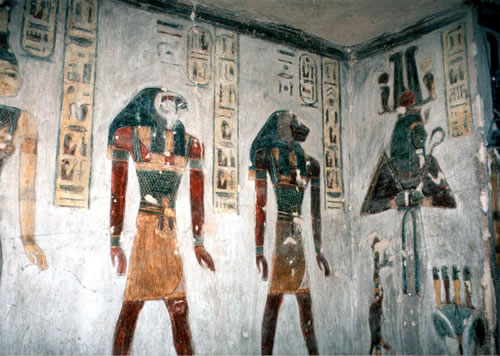
Cameras were not allowed to be taken into the Valley of the Kings.  We were able to enter the tombs of Ramses I, Ramses III, and Ramses IX.  We also saw the tomb of King Tut (Tutankhamun) which was the best preserved of all of the tombs.  It wasn't discovered until 1917 and finally opened in 1922--with the treasures and the mummy still in place.  Most of the tombs were robbed earlier and the artifacts scattered throughout the world.

(The next 4 photos were copied off of the internet)

http://aaronandzoe.goannatravel.com/gallery/d/68-2/Valley+of+the+Kings+View+_Medium_.jpg
The Valley of the Kings--sleeping place of the Pharaohs.  62 known tombs are located in this valley.
 http://www.holtzendorff.com/vacations/israel/images/ramses-iii-valley-of-the-kings.jpg
 Paintings on the wall of a pharaoh's tomb.
http://medj.com.au/wp-content/images/egypt/Egypt-Valley_Of_Kings_2006-01_06_resize.jpg
Egyptian hieroglyphics in a tomb.
 http://www.touregyptphotos.com/data/504/186134-3451_img-med.jpg
Sarcophagus of Ay--Pharaoh